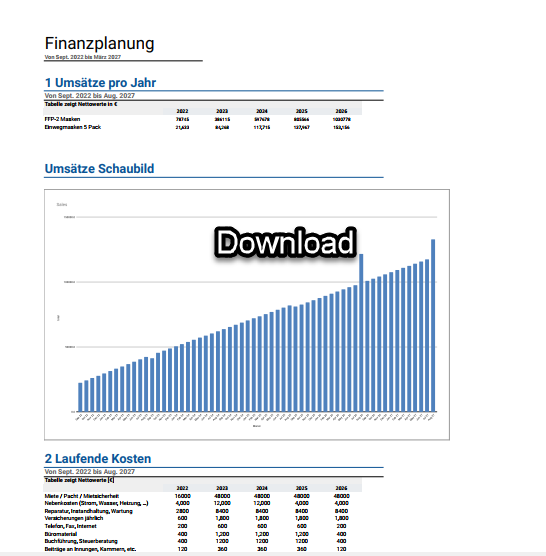

Create a financial plan for the restaurant industry
When founding a restaurant business, it's hard to do much wrong. Or is it?
Whether with friends or alone, enjoying a delicious meal in a pleasant atmosphere is something most people appreciate. Yet building such a place should not be underestimated. Competition is intense and often hard to assess at the start. This is one reason for the above-average failure rate in the restaurant industry.
To avoid such a scenario, a well-thought-out financial plan is indispensable.
As is well known, the scope of the financial plan is determined by the respective industry. When it comes to founding a hospitality business, you have to expect larger investment expenses than, for example, when setting up a law firm or a tax consultancy.
Here we want to provide you with a guide that accompanies you on your path to self-employment and to achieving your goals. We will show you what to pay attention to when planning the finances of a hospitality business.

Before you start drawing up your financial plan, it is advisable to address the following points in preparation. Only if you have sufficient information can you make a realistic forecast and save unnecessary costs later on.
The first two points are part of the company description of your business plan. At the same time, they form the starting point of financial planning. That is why we find it useful to mention them here as well.
1. Market and competitive analysis
Know your industry. This is primarily about always keeping an eye on the market, its development and your competitors.
In particular, you should address the following points:
- Number of businesses in the gastronomy and restaurant sector
- Types of operations (cafés, snack bars, ice-cream parlors, restaurants, etc.)
- Annual revenue and how it is distributed across different types of operations
- Number of employees, their compensation, and qualifications
- Business demographics (showing, among other things, how many new businesses survive the initial years and achieve sustained positive development)
- Trends
Next, take a closer look at the statistics that relate to your market niche. These are of great importance to you as a founder.
Market research is time-consuming but will help you with the next step: preparing the revenue and cost plan. You can find more information on the current state of the restaurant industry here. The COVID crisis, inflation, and technological progress over the past few years have shown how important a certain degree of adaptability is for running a business.
For this reason, you should absolutely take the latest trends into account in your financial plan. Consider whether online ordering and delivery are included in your offering.
2. General preparations and assumptions
Have you gathered enough information about the market situation? Congratulations. You have taken the first and most important step toward turning your dream into reality. You are now ready to begin the general preparations and assumptions.
2.1. Company characteristics
Think about what makes your business special. What added value do you offer potential customers compared to your competitors? What is your unique selling proposition? Do you, for example, offer only regional and fresh products, or do you prepare national cuisine that can rarely be found elsewhere in the area? Does an outstanding view make a stay at your restaurant particularly pleasant? Describe these advantages in your business plan and use them in your marketing strategy to attract more customers.
2.2. Target audience and buyer persona
This point is closely tied to your business positioning strategy. It determines how you will set yourself apart from the competition. Do you plan to compete with a significantly lower price? Or will your customers have to dig deeper into their pockets to afford your services? Another way to win customers over is the niche strategy. In this case, you focus on a tightly defined market segment and differentiate yourself from competitors through your unique skills and expertise.
Buyer Persona: The buyer persona is a fictional person who represents your ideal customer. By assigning specific characteristics, you give your customer base a concrete face. This makes the needs, considerations, and actions of your own customers more visible, allowing you to align your offering optimally.
2.3. Choose your legal form
Germany does not prescribe a single, mandatory legal form for restaurant businesses. Even so, most companies in this industry adopt one of the following forms:
- Sole proprietorship
- GbR (civil-law partnership)
- OHG (general commercial partnership) and GmbH (limited liability company)
Which form is right for you? To determine this, ask yourself the following questions:
- How many employees will there be?
- Who is liable in case of damages?
- How much capital can I count on from the very beginning? Registering a GmbH, for example, requires share capital of 25,000 euros.
- How high may the administrative costs of a legal form be?
Because companies are taxed differently depending on their legal form, we recommend discussing the various options with a startup advisor and/or attorney.
2.4. Staff
To keep the workflow running smoothly, be realistic about your personnel planning.
- Which specialists do you need, and how many?
- Who is responsible for what?
- What is the average wage of your future employees?
2.5. Location
A good location plays a major role, especially for new businesses. In the restaurant industry in particular, the location is decisive for the future of your company. You should absolutely take the needs of your buyer persona into account here (see also definition: point 2). Factors such as parking options, special features of the surroundings, and street traffic should be considered.
2.6. Where will you source your ingredients?
Great food is made not only of passion, but also of great ingredients. When looking for the right partners, try to find affordable options, but be careful: never compromise on quality. Beyond quality and price, possible delivery routes should also be considered. A short delivery route is advantageous, for example, when you want to offer fast service.

2.7. Define the planning horizon of your financial plan
In the case of loan approval, banks and investors usually prefer a forward-looking financial plan. A longer planning horizon during planning is therefore an advantage.
3. Revenue and sales planning
When writing your financial plan, do not confuse units sold (Absatz) with revenue (Umsatz). There is a clear distinction between the two. Units sold refers to the quantity of units sold (whether a product or a service). This figure indicates only quantities, not monetary amounts.
Revenue, by contrast, indicates how much money was generated through sales. Another word for revenue is proceeds. It is calculated as follows:
REVENUE = Quantity (units sold) × Price
To be able to calculate revenue, you must first:
- Define your own products/services precisely. If, for example, you offer different lunch packages, breakfast, brunch, lunch, and dinner are listed here as exact definitions of the product.
- Set the sales prices for the various offerings.
- Make an estimate of the number of customers. Planning the number of lunch packages sold per unit of time is also required (breakfasts sold per day, per month, etc.).
In order to forecast these realistically, ask yourself the following questions:
- How many meals can you prepare per unit of time (per day, per morning, lunch, etc.)?
- How many can you sell?
Here is an illustrative example
You have 20 tables and 80 chairs. Your maximum capacity would therefore be 80 brunches at the same time. Suppose all 80 seats are filled a second time. You would then need 160 brunch packages to satisfy all customers. Let us assume you offer two different brunch packages.
You sell the first one for 15.00 € and the second for 12.00 €. On average, you earn 13.50 € per meal. That results in 2,160.00 € of revenue from brunch packages alone per day (not to be confused with profit).
It makes sense to picture the best-case scenario, i.e., full capacity utilization. However, especially as a founder, do not assume that the number of customers will be that high right from the start.
At first, try to plan with only a small percentage of capacity utilization. This gradually increases over time. To avoid being caught off guard by unpleasant surprises, you should include a buffer. For example, create a scenario in which there is no revenue for the first two to three months. Capacity utilization is therefore 15%, but it rises over the following months and into the next year. By the end of the following year, it has already reached 40%.
We have now given you an example so that you can picture the process. Of course, you should only base these assumptions on detailed market research. Partner conversations, industry reports, trend studies, and so on can help you here.
If possible, you can also try to create your own surveys. Conduct them with your potential customers to gather valuable information directly from them.
Repeat this procedure with the other products you offer in order to calculate total revenue.
Revenue and costs are mutually dependent. The higher your income, the higher your costs will be. It is therefore very important to make estimates here that are as realistic as possible.
4. Cost planning
4.1. Material costs — cost of goods
Costs that rise or fall directly with revenue, or that are incurred while preparing your dishes, are called material or cost-of-goods-sold costs. They are therefore also known as variable or revenue-dependent costs. If you want premium quality, you will probably have to accept higher material costs. High-quality ingredients are usually more expensive but, in any case, lead to delicious specialties.
4.2. Personnel costs
Personnel costs are all costs that arise from employing staff. They are often the largest outgoing cost item. A careful review should therefore be carried out here.
A common mistake here: new founders often forget to budget for their own salary as well. Depending on the legal form of the company, this is calculated either as a managing director salary (for corporations) or as a private withdrawal (for partnerships).
Personnel planning should also be aligned with revenue growth. You cannot expect higher capacity utilization without enough staff.
Special features in the restaurant industry
In the restaurant industry in particular, you should take seasonal effects into account and adjust the number of staff accordingly. A core team forms the foundation of any successful business.
Another way to expand staffing without enlarging the core workforce is to hire part-time staff and/or mini-jobbers.
4.3. Marketing costs
When determining your marketing costs, think about the impact that specific expenses will have. Try to invest precisely where it pays off.
Which marketing channels could you use to attract your desired customers (the target group)?
That depends on your characteristics. To attract students, for example, you may need to use a different marketing strategy than for a mid-sized business. The same applies to marketing channels. Do not see marketing spend as an unpleasant cost but as a source of your revenue.
4.4. Operating costs
Operating costs are also referred to as fixed costs. Unlike material costs, they do not depend on production volume. Here are a few examples:
- Rent
- Service charges (rental incidentals)
- Cleaning
- Accounting and tax advice
- Internet fees, and so on
5. Start-up costs and investments
Founding costs refer to the total expense of creating the legal existence of the company. They arise only once, when you found your business. Founding costs depend on the legal form and therefore vary accordingly. In principle, the following are included:
- Fees for trade registration
- Entry in the commercial register (not required for a sole proprietorship, but required for a GmbH)
- Attorney and notary fees
- Startup advisory costs
- Costs for a tax advisor
- Permit costs – depending on what you offer, you may need a so-called restaurant license (e.g., when selling alcohol)
Investments refer to economic assets (fixed assets) that are used in the company for more than one year. The payments for investments are included in the liquidity plan but are not considered costs.
Investments are needed, for example, to purchase machinery and/or technical equipment. Furnishings for the kitchen and/or sanitary facilities are also covered here. Divide these into corresponding segments such as:
- Investments that fall under venue furnishings are incurred
- Investments that fall under kitchen equipment are incurred
For example, if you have budgeted 60,000 € for kitchen planning, list every single expense together with its price, as follows:
- Stove: 2000 €
- Freezer: 1400 €
- Cookware: 800 €, and so on
Another component of investments is renewal investments. To keep pace with the market, innovations should be introduced from time to time.
6. Liquidity and financing
The liquidity plan compares expected cash inflows and outflows within a defined period. Among other things, it serves as a forecast of the cash flow, which is automatically derived from previous entries in the financial plan. Because revenue and incoming payments often do not match, the liquidity plan helps us follow the development of the cash flow. Potential liquidity shortfalls are thus identified in time.
The liquidity plan serves to avoid these and to take appropriate countermeasures in good time. Unforeseen costs and delayed payments are risks faced by every business. Liquidity reserves or safety buffers should therefore be planned. These reserves are usually covered by equity as well as various financing options. Above all, however, equity should be used as the primary source of financing.
In Germany there are various financing options. Most often these are startup loans. Some additional options are:
- Equity
- Bank loans
- Government funding programs
At this point in the financial plan, you should also explain how you plan to cover the initial investments. If you have equity and have also decided on a loan, you should break down both positions in detail.
7. Profitability
Finally, the financial plan should give you, as future management, an answer to the most important questions:
- Is your business idea worthwhile?
- Are the prerequisites in place to generate a profit?
- Will this cover your costs and ultimately produce gross profits?
- Will you be able to support your own livelihood and still afford a few extras?
The profitability calculation provides a clear answer to this.
Profitability calculation
A profitability calculation compares planned revenue with planned expenses and normally covers three full business years. This part represents the expected profit-and-loss statement of the company.
The key component of a profit-and-loss statement is best calculated as follows:
- Calculate the gross profit: Gross profit = Revenue – Direct costs
- Now deduct the gross profit from founding, personnel, and operating costs as well as from depreciation. This yields the operating result: Operating result = Gross profit – Founding, personnel, and operating costs
- Calculate the result before tax by subtracting any interest from the operating result.
- In the end, you will arrive at either a profit (net) or a loss figure. However, it is also possible to have a loss year, which is particularly common at the end of the first business year. Do not let this discourage you. Many companies finish their first reporting year without a profit. What matters is the ability to change this in the near future: Net profit = Result before tax – Tax
After you have created the financial plan, the next step follows: the SWOT analysis. This involves identifying your strengths, weaknesses, opportunities, and risks so that concrete strategies can be derived.
Support options
As you can see for yourself, there is a lot to consider before founding a restaurant venture. It is completely normal to sometimes feel overwhelmed by it. Fortunately, many support options are available to you. One of these is the AVGS coaching that we offer.
It prepares you for all relevant topics before founding. In addition, it is 100 percent funded by the Federal Employment Agency and is therefore free for you. Seize your opportunity!