
How to Start Your Own Driving School
Are you a driving instructor earning your living through teaching? Driving schools are indispensable in our daily lives because mobility means freedom. With your own driving school you can increase your income and realize your vision of ideal instruction. There are a few requirements to meet, but founding one is feasible and worthwhile.
We have gathered experience with driving school founders and know: a driving school can be a stable and profitable business idea. In this article we show you how to open your own driving school and successfully get started.
1. Requirements for the driving school license
Before you are allowed to open a driving school, you have to apply for the driving school licence. You obtain this from the relevant state authority or a subordinate authority, depending on the federal state. For the application to be approved, the following requirements must be met:

- Age: You must be at least 25 years old.
- Professional experience: Two years of full-time activity as a driving instructor.
- Driving licence: You must have held the driving licence class BE for at least three years, plus additional classes depending on the services you plan to offer.
- Points in Flensburg: No more than one point may be registered in the driver suitability register.
- Driving experience: Before training begins, you must be able to prove at least 30,000 kilometres driven.
- Eye test: A passed eye test is mandatory.
- Continuing education: A completed driving instructor training and continuing education as a driving school business administrator are required.
- Infrastructure: A suitable classroom with the necessary teaching materials as well as at least one training vehicle must be provided.
An additional fee of approximately 100 to 110 euros is charged for the driving school licence application.
2. Choosing a legal structure and registering your driving school
The choice of legal structure influences how you are liable, how much tax you have to pay and how much bureaucracy is involved. As soon as you have chosen a legal structure, you officially register your company.
Which legal structures are suitable?
There are several legal structures that are suitable for driving schools. Here are the most common options:
Sole proprietorship
Advantages:
- Simple and inexpensive to set up.
- No minimum capital required.
- You have full control over your company.
Disadvantages:
- You are liable without limit with your private assets.
- The tax burden can be higher as profits increase.
Sole proprietorships are particularly suitable for smaller driving schools run by a single person.
Limited liability company (GmbH)
Advantages:
- Limited liability: you are only liable with the company's assets, not with your private assets.
- More professional appearance with business partners and customers.
Disadvantages:
- Higher start-up costs, since a minimum capital of 25,000 euros is required (of which 12,500 euros as a cash contribution).
- More complex administration and accounting.
A GmbH is ideal if you have bigger plans and want to employ several staff members.
UG (limited liability)
Advantages:
- Similar to the GmbH, but with significantly lower minimum capital (from 1 euro).
- Limited liability protects your private assets.
Disadvantages:
- Initially, part of the profits must be retained in order to build up the share capital.
- May appear less serious compared to a GmbH.
The UG is an affordable alternative to the GmbH and offers a good entry option for founders with limited start-up capital.
Registering your driving school
Once you have chosen the right legal structure, you have to officially register your company. Here are the most important steps:
Business registration:
Register your driving school at the relevant trade office. For this you need:
- Your ID card or passport.
- The driving school licence you have applied for at the state authority.
- The chosen legal structure (for GmbH or UG: commercial register entry).
Entry in the commercial register (for GmbH/UG):
For limited companies, an entry in the commercial register is mandatory. This is done through a notary.
Tax office:
After registering the business, the tax office will contact you. You will receive a tax number and have to decide whether you want to opt for the small business regulation (for revenue up to 22,000 euros per year).
Employers' liability insurance association and insurance:
As an entrepreneur, you must register your employees with the employers' liability insurance association. In addition, you should adequately insure your business, for example with professional liability insurance.
Tip for choosing a legal structure
Consider which legal structure suits your business idea. If you start small, a sole proprietorship is often enough. If you want to grow in the long term and minimize risks, a GmbH or UG could be advisable. If in doubt, talk to a tax advisor or start-up consultant to make the right decision.
With the right legal structure and official registration, you are already one big step closer to your goal of running your own driving school!
3. Costs of setting up a driving school: an overview
Setting up a driving school is an exciting and potentially lucrative venture, but it is associated with a wide range of costs. These can vary significantly depending on personal situation, location and the size of the business. Below you will find a structured overview of the main cost factors as well as some tips on how to optimize expenses.
What does continuing education to become a driving instructor cost?
Continuing education to become a driving instructor is one of the highest cost factors when setting up a driving school, especially if this qualification is not yet held. The total costs depend on the training provider and on your personal starting point. On average, the costs amount to:
- Duration of training: 12 months
- Costs: Between 14,000 and 18,000 euros
Money-saving tips:
- Tax deductibility: Many training costs can be claimed for tax purposes.
- Government grants: Check funding programmes such as start-up funding or continuing education subsidies.
- Use advisory services: Start-up and funding consultations can help to find the right support offerings and avoid unnecessary costs.
Vehicle selection and their costs
Vehicles are an essential part of every driving school. Their selection should be carefully thought out as they influence both the learning atmosphere and the operating costs.
| Kosten pro Fahrzeug |
|---|
| 18.000 bis 35.000 Euro |
What to look out for when choosing a vehicle?
- Safety: Choose vehicles with modern safety standards, e.g. ABS, airbags and reversing cameras.
- Easy handling: The cars should be easy to operate to make it easier for beginners to get started.
- Sustainability: Electric and hybrid vehicles are becoming increasingly popular. They are not only environmentally friendly but can also be a competitive advantage.
Other important cost items
The costs of setting up a driving school go beyond continuing education and vehicle purchase. Here is an overview:
| Kostenpunkt | Details | Kosten |
|---|---|---|
| Mietkosten für Räumlichkeiten | Variiert stark je nach Standort | Abhängig von Region und Größe |
| Einrichtungskosten | Möbel, Tische, Stühle, Empfangsbereich | 3.000 bis 6.000 Euro |
| Fahrschulsoftware | Verwaltungssysteme, oft pro Schüler oder monatlich | Einmalig oder monatlich |
| Lehrmaterialien | Bücher, Prüfungsbögen, Lernapps | 500 bis 1.000 Euro |
| Versicherungen | Haftpflicht-, Fahrzeug- und Betriebshaftpflicht | Abhängig vom Umfang |
| Marketing | Website, Social Media, Flyer, Eröffnungsaktionen | 500 bis 5.000 Euro |
| Beratungskosten | Rechts-, Steuer- oder Gründungsberatung | 1.000 bis 3.000 Euro |
4. Business plan for your launch
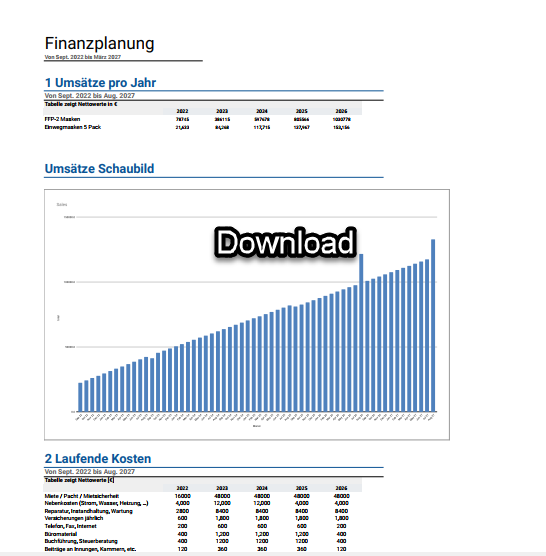
Now that you already have an overview of the costs involved, you can start with the detailed planning of your driving school. In addition to one-off acquisition costs, ongoing costs will of course also arise, such as rent, staff salaries, vehicle maintenance and marketing. Don't be discouraged if the total seems overwhelming at first glance - such investments are normal, especially for a venture like setting up a driving school.
To overcome this financial hurdle, many founders take out bank loans. But to convince a bank or other potential investors, you absolutely need a well-prepared business plan. This plan not only helps you to clearly formulate your ideas and goals, but also to create confidence in your founding competence.
What belongs in the business plan?
A bank-approved business plan should contain the following points:
- Financial plan: Detailed list of your costs, broken down into fixed, variable and one-off expenses. Also show how you intend to cover operating costs and generate profits with your revenue.
- Location analysis: Describe why your location is ideal. Are there enough potential learner drivers in the area? Is your driving school easily accessible?
-
Unique selling points: What makes your driving school special? Consider whether you can stand out with special offers, e.g.:
- Driving licence courses for special target groups: seniors, people with driving anxiety or licence converters.
- E-mobility: offer learner drivers the option to drive electric or hybrid cars. Sustainability is becoming increasingly important and could give you a clear advantage.
- Intensive courses: fast-track driving licence courses for learner drivers under time pressure can be in particularly high demand.
- Marketing strategy: Explain how you want to attract students - whether through a modern website, social media presence or local advertising.
- Your profile: Tell something about yourself. Your qualifications, your motivation and your experience as a driving instructor can build trust.
A well-structured and convincing business plan is not only a tool to convince investors, but also helps you yourself to concretize your vision and identify potential pitfalls early.
5. How much can you earn as a driving school owner?
The earnings as a self-employed driving school owner depend on several factors, including the size of your driving school, the number of students and the prices for your courses. On average, a well-run driving school in Germany can generate revenue between 10,000 and 30,000 euros per month.
Of course, the operating costs must be covered from this. These can amount to 60-70 % of revenue, depending on factors such as rent, vehicle costs and marketing. In the end, as an owner you can expect a net income between 3,000 and 7,000 euros per month, and significantly more for larger driving schools with several employees.
It is important that you calculate your prices strategically. A good benchmark is to orient yourself on the average prices in your region, while still focusing on a high-quality offering that convinces students.
6. Conclusion
Setting up a driving school is a demanding but rewarding task. Those who plan well save not only time and nerves, but also money. With a well-thought-out business plan, a clear vision and a focus on quality and customer orientation, you can lay the foundation for a successful driving school.
Keep in mind that the founding is only the beginning. Your long-term success depends on how flexibly you react to market changes and how well you understand the needs of your students. With good preparation and commitment, a successful future as a driving school owner awaits you!