
Writing a Business Plan for Your Hair Salon
Tips for a successful start in the hair salon business!
Planning to open a hair salon and already have concrete ideas but still need help writing the business plan? We give you an overview of the most important aspects you should know and consider.

1. Is a business plan really necessary for a hair salon?
Absolutely! The business plan is one of the most important tools during the startup phase of your company. It also serves as a benchmark for you as a founder. You can measure your progress against it, since the goals it formulates should be reviewed regularly and adjusted if necessary.
2. How do I create a business plan for my hair salon?
When you think about implementing your business plan, you should have a clear idea of how you envision your hair salon. Specifically, you define your target group, meaning who your business idea is aimed at. Are you targeting customers of all ages and genders, or do you want to open a hair salon aimed exclusively at women, for example? Your strategy is equally important. Your business plan must explain how the business idea is meant to work, that is, how you deliver your services. Possible questions include:
- Do you have enough staff?
- Where will you source your products?
- Do you already have a suitable retail space?
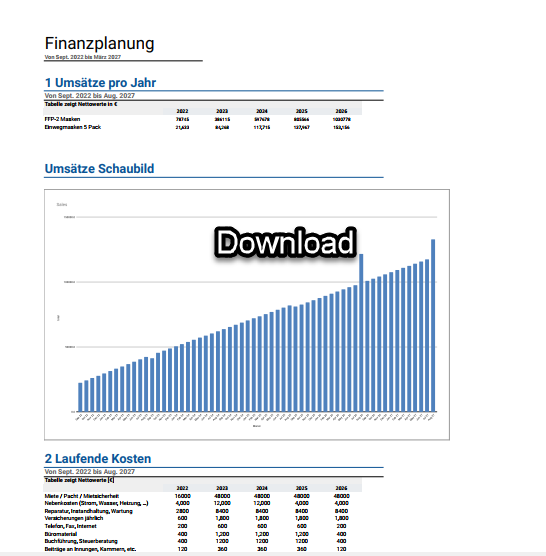
You also need to think about potential risks. Another pandemic could occur and your hair salon might only be allowed to open with restrictions. Another important point is finances. The financial plan determines whether your business idea is actually worthwhile. You may now be asking yourself: where do I get a business plan? To give you an idea of what such a business plan can look like, you can download a corresponding free business plan template here.
3. What do I need to consider when creating a business plan?
Qualifications are essential!
If you want to fulfill the dream of your own hair salon, you first need to know which qualifications are required. Since hairdressing is one of the trades requiring a licence in Germany, you need a completed master craftsman's examination to open your own hair salon. If you do not hold a master's qualification, you must prove a journeyman's certificate in the relevant trade for at least six years and a managerial role in the hairdressing trade for at least four years. This can be verified through employer references. Alternatively, you can hire a master hairdresser as your manager. This way the master craftsman requirement in the hairdressing trade is also fulfilled.
Language matters!
Your business plan must be formulated clearly and intelligibly, because not everyone is familiar with the hairdressing business. Even laypersons should be able to understand your founding idea. Technical terms from the industry or foreign words should therefore be avoided. If such words are used anyway, they must be explained. It is advisable to back up arguments with a factual writing style, as this comes across as more credible than exuberant explanations. Since several people may work on a business plan, a final proofreading round is recommended once the text section is complete.
Format and length of your business plan
The format and length of your business plan also play an important role. A clear, appealing layout creates interest in the reader. After all, your goal is for your business plan to be read in full and for no detail to be overlooked. As an example, instead of long passages of text, write short paragraphs and choose a legible font. Fonts such as Calibri, Arial or Times New Roman are recommended. The distance from the text to the margin also distinguishes a good business plan. Don't make the margins too narrow; leave a bit of space.
Once you have addressed the format, it is time to consider the length of your business plan. The founding project is decisive here. So if you are planning a hair salon that includes not only washing, cutting and coloring, but also fitting hair extensions, styling and selling hair care products, your business plan will be more extensive. Ideally, the business plan is 20 to 25 pages long, although the number of pages can vary slightly upwards or downwards. However, it is important to note that the business plan must be no fewer than 15 and no more than 30 pages.
The cover page
In addition to a serious writing style and the right layout, the structure of your business plan is also of great importance. The first page consists of a cover page with the company name and a suitable photo. This is followed by the contact details of the founder. This includes the name, address, telephone number, email and, if applicable, a website address, in short URL. We show you how to create a cover page in another article.
Which points must a business plan for a hair salon include?
In addition to a serious writing style and the right layout, the structure of your business plan is also of great importance. The first page consists of a cover page with the company name and a suitable photo. This is followed by the contact details of the founder. This includes the name, address, telephone number, email and, if applicable, a website address, in short URL.
- Executive Summary
Now the text portion of the business plan begins. It starts with writing the executive summary, in which the content of your business plan is summarized. For example, you provide information here about your concept for the hair salon and an outlook on what makes your idea special. The executive summary is very important because, for example, the bank gets a first overview of your founding idea from it.
- Business concept
Now follows your business concept. Under the heading offering and product range, you provide an overview of which products and services are offered in your hair salon. This includes all products you sell in addition to your services, such as hair care products. You also describe your services under offering and product range. You describe which services customers can take advantage of in your hair salon. This includes, for example, washing, cutting, blow-drying, coloring and styling. Additional services such as makeup or styling festive hairdos are also presented here. You do not need to disclose prices here; this is covered in the financial plan section of the business plan.
- Premises
The premises in which you intend to operate your hair salon are also part of the business concept. In this part of the business plan, you provide information about the company address and describe the surroundings, so that the bank gets an overview of where your shop is located and whether it is easily accessible and visible to customers. If you already have photos of the premises, they should definitely be included here so that the bank gets an impression of the hair salon.
- Customers and target group
After you have described what the hair salon will look like, the next point describes your customers and target group. This can be, for example, people from childhood to adulthood who want to use the services of washing, cutting, blow-drying and coloring, as well as people who want suitable styling for a festive occasion.
- Customer benefit
The customer benefit shows the bank why your target group will come to you specifically. Here you describe the concrete added value customers gain from your offering - whether it is time savings, a unique styling experience or particularly gentle care products.
- Unique selling point
In the next step, you highlight your unique selling point. Here you show what sets you apart from your competition. You highlight features that make your business idea special. This includes, for example, the offering of care products that are high-quality or from a specific brand and are not part of the range at other hair salons. You could also use a hair coloring product that is environmentally friendly and gentle on the hair. Another possibility for a unique selling point could be offering a mobile hairdressing service. So you don't only want to look after your customers in the salon, but also outside, at their home, for example.
- Market potential
For your business formation it is important to also consider the market potential. In this section, for instance, charts can be used to show how often a visit to the hairdresser is made by customers. Another point could be the growth potential of services such as hair extensions, meaning how much demand there is for this service. This section shows the bank that there is demand for the services you offer and that your salon can therefore operate in an economically sensible way.

- Advertising and marketing
Having a broad range of products and services is well and good, but you have to draw attention to your salon. This is addressed under the heading advertising and marketing. Here you list the types of advertising and marketing in your business plan. For example, flyers are distributed, you run a website and additionally do social media marketing. An Instagram account, for example, can be a good fit here. However, what kind of advertising and marketing is suitable depends on your target group. If, for example, your business idea mainly addresses seniors, word of mouth and distributing flyers are more advantageous advertising than an Instagram account.
- The founder
You yourself are also important in your business plan. Under the heading the founder, the skills you have to successfully run a hair salon are highlighted. Your qualifications are listed here, for example.
- Legal structure
Your hair salon absolutely needs a legal structure. The legal structure you choose depends on various factors. These can be, for example, the startup capital and liability. Options for self-employment are sole proprietorship, partnership or limited company.
- Distribution
The distribution section reports on how your products and services reach customers. For example, the workflow from the customer making an appointment to the completion of the service is described. Another example is the sale of hair care products via the internet. You might offer hair care products through an online shop; in that case the distribution section describes the steps from the customer placing an order to the customer making payment.
- Potential risks
For your business formation you must also consider potential risks. For example, an employee in your salon does not observe the dwell time of a bleach and the customer suffers damage in the form of scalp burns. The customer will most likely demand compensation and damages for pain and suffering. For such cases, professional liability insurance is recommended.
- Further planning
In principle, it is important to focus on the here and now. However, in your business plan you should also think about the future plans for your hair salon. You may want to open additional salons, hire more staff or - if not yet included in the current business idea - offer a mobile hairdressing service.
- Financial plan
After the text section ends with further planning, the financial plan follows. Here the business development is presented in figures and at the same time it shows how much capital is necessary to finance your self-employment.
4. What is a financial plan for my hair salon?
The financial plan is meant to give an overview of how high the expenses will be and at what level the income of your hair salon needs to be. This is necessary because it determines the prices for the services you offer. A serious financial plan forms the backbone of your business plan. Here, the financial resources available are listed, as well as how much capital is needed. Furthermore, the services offered and the resulting revenue are stated. Examples of this include listing the services of washing, cutting, blow-drying, coloring, styling and fitting hair extensions. The respective revenue is then specified according to the unit in which the service is delivered. This can, for example, be in months, hours or as a quantity.
Revenue and costs
The list also includes the products that will be sold. That means if, for example, hair care products, hair spray, hair wax or hairbrushes and combs are sold in your hair salon, they are stated as a line item in the financial plan. Another important part of the financial plan is personnel costs. Here you list how many employees will work in your hair salon, what kind of employment relationship these people have (for example as part-time help or full-time employees) and what wage you as an employer will pay your employees each month.
Liquidity planning
In addition, a liquidity forecast is created and special attention should be paid to investment planning as well as profitability planning. This planning is important both for you as a founder and for potential investors, such as the bank, since this is how the economic development of your hair salon is assessed. So that you know what a financial plan can look like, you can find a free template for a financial plan for a hair salon at the following link.
Can I receive financial support?
A financial boost can be a great help in mastering the start of self-employment. Various funding programs are available for this. To obtain funding for consulting services, we at Businessstart.eu recommend the funding for entrepreneurial know-how or funding within the framework of an AVGS voucher.
5. Can I write a business plan myself?
The business plan, including the financial plan, is a very important document when founding a company. That is why a professional preparation of the business plan is highly recommended. A good business plan can in principle be written by yourself, but a lot of time and preparation is necessary. Experts compile a business plan using their expertise, so that in the end a credible business plan can be presented to the bank. Professional support is especially recommended for the financial plan. We at Businessstart.eu support you with advice, prepare the perfect business plan for you and optimally prepare you for your business formation.