Table of contents
- 1. What is a marketing analysis?
- 2. The 5 components of a marketing analysis
- 3. Market analysis: understanding size and trends
- 4. Conducting a competitor analysis
- 5. SWOT analysis with template
- 6. Concrete example: opening a café
- 7. Free tools for your analysis
- 8. The 5 most common mistakes
- 9. Marketing analysis with Business Start Software
Video: marketing analysis simply explained
The YouTube video will be embedded here
You want to start a business but don't know if your idea will work in the market? A Marketinganalyse gives you the answers. It shows you how big your market is, who your competitors are and whether there are enough paying customers.
In this guide you learn step by step how to build a professional marketing analysis - even without a marketing degree.
1. What is a marketing analysis?
A marketing analysis is the systematic study of all factorsthat influence the success of your business. It answers the key questions before founding:
- Is there a market? How big is it and is it growing?
- Who are the customers? What do they really need?
- Who is the competition? What do they do well or poorly?
- What makes you special? Why should customers come to you?
- What are the risks? And how can you minimize them?
Why the marketing analysis is so important
The marketing analysis is a mandatory part of any business plan. Banks and investors check especially critically whether you understand your market. A good analysis shows that you are not just dreaming but deciding based on data.
2. The 5 components of a marketing analysis
A complete marketing analysis consists of five building blocks that build on each other:
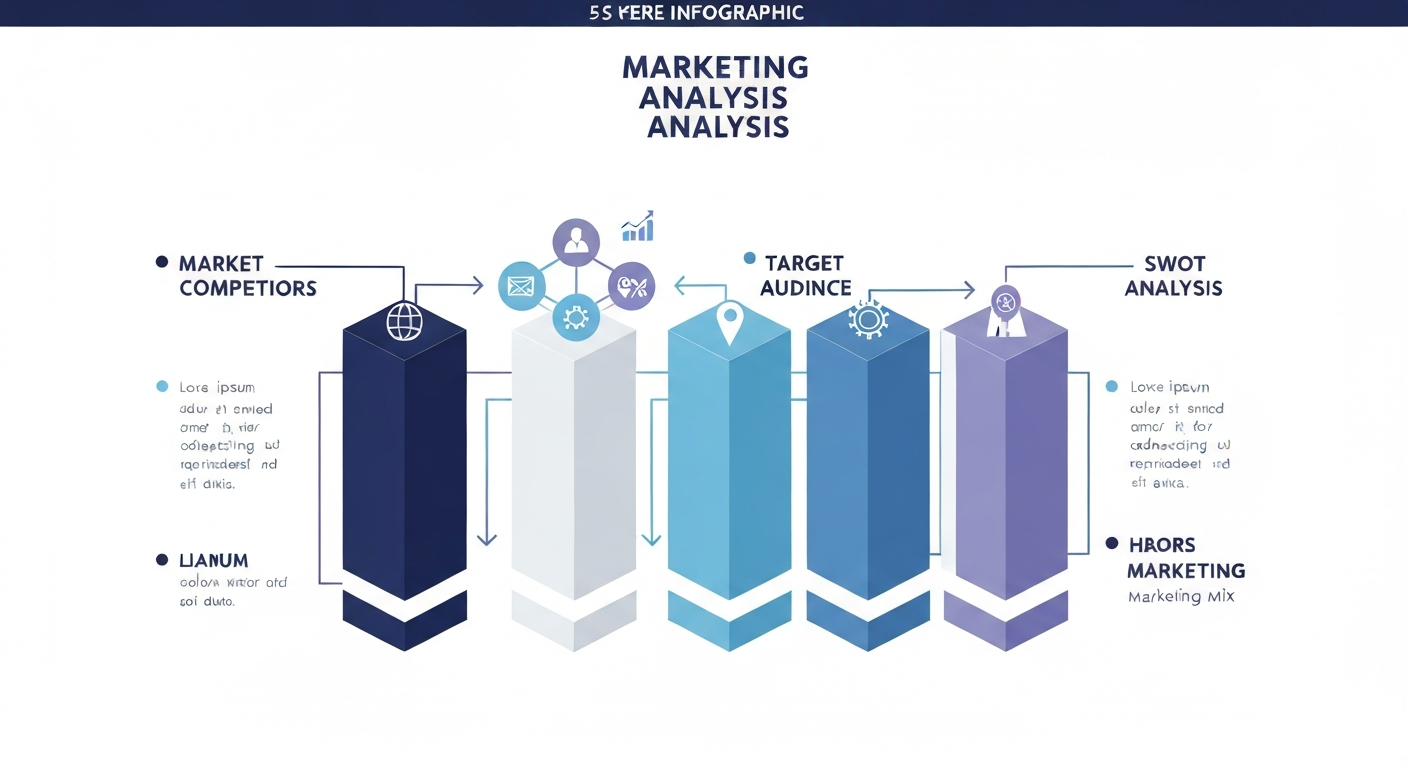
1. Market analysis
How big is the market? What trends exist? Is it growing or shrinking?
2. Competitor analysis
Who are your competitors? What are their strengths and weaknesses?
3. Target group analysis
Who buys your product? What are their needs and pain points?
4. SWOT analysis
Strengths, weaknesses, opportunities and threats - all at a glance.
5. Marketing mix (4Ps)
Product, Price, Place and Promotion - the four pillars of your marketing strategy. You develop them based on the insights from the first four analyses.
Tip: Haven't done the target group analysis yet? Then first read our guide on finding your target group.
3. Market analysis: understanding size and trends
The market analysis answers the fundamental question: Is the market big enough for your business?
These KPIs you need:
| Kennzahl | Bedeutung | Beispiel |
|---|---|---|
| TAM | Total Addressable Market - Gesamtmarkt weltweit | Globaler Kaffeemarkt: 495 Mrd. USD |
| SAM | Serviceable Addressable Market - Dein erreichbarer Markt | Café-Markt Deutschland: 8 Mrd. EUR |
| SOM | Serviceable Obtainable Market - Realistischer Marktanteil | Cafés in deiner Stadt: 2 Mio. EUR |
Common mistake: TAM instead of SOM
Viele Gründer präsentieren den riesigen Gesamtmarkt (TAM) und vergessen, dass sie nur einen winzigen Teil davon realistisch erreichen können. Konzentriere dich auf den SOM - das ist die Zahl, die für deinen Businessplan zählt.
Wie du den SOM aus TAM und SAM konkret ableitest, zeigen wir Schritt für Schritt an einem Beispiel im Ratgeber Marktpotenzial berechnen — inklusive Formel, Marktvolumen und Marktanteil-Schätzung.
Where to find market data?
- Statista: Umfangreiche Marktdaten und Branchenreports
- Destatis: Offizielle Statistiken des Statistischen Bundesamtes
- IHK-Reports: Branchenspezifische Analysen deiner Region
- Google Trends: Suchtrends und saisonale Schwankungen
- Branchenverbände: Oft kostenlose Jahresberichte
4. Conduct a competitive analysis
The competitive analysis shows you who you are up against — and where your chances lie.

Step 1: Identify competitors
Differentiate between:
- Direct competitors: Offer the same product/service (another café)
- Indirect competitors: Solve the same problem differently (bakery with coffee)
- Substitutes: Replace your product completely (coffee at home)
Step 2: Analyze competitors
For each competitor, find out the following:
Offering and prices
What do they offer? At what prices? Are there discounts or bundles?
Target group
Whom do they target? Is there a niche they ignore?
Marketing and channels
Where do they advertise? Social media, Google Ads, locally? What works for them?
Read reviews
Google reviews show strengths and weaknesses from the customer perspective. Worth gold!
Pro tip: Mystery Shopping
Become a customer of your competitors yourself. Buy their product, test their service, experience their customer journey. You will learn more in an hour than from days of online research.
5. SWOT analysis with template
The SWOT analysis brings all insights together. It shows you at a glance where you stand.
What does SWOT mean?
- Strengths (Stärken) - Was kannst du besser als andere?
- Weaknesses (Schwächen) - Wo musst du aufholen?
- Opportunities (Chancen) - Welche Trends kannst du nutzen?
- Threats (Risiken) - Was könnte schiefgehen?
SWOT template to fill in:
Strengths (internal)
- Your expertise and experience
- Unique product/service
- Location advantage
- Strong network
Weaknesses (internal)
- Limited resources
- Lacking experience in certain areas
- Dependence on suppliers
- Unknown brand
Opportunities (external)
- Growing market
- New trends (e.g. sustainability)
- Weak competition
- Technological developments
Threats (external)
- New competitors
- Economic uncertainty
- Regulatory changes
- Price wars in the market
How to use the SWOT analysis correctly
Stärken + Chancen: Hier liegt dein größtes Potenzial. Fokussiere dich darauf!
Schwächen + Risiken: Hier musst du aufpassen. Entwickle Strategien zur Risikominimierung.
Stärken + Risiken: Nutze deine Stärken, um Risiken abzuwehren.
Schwächen + Chancen: Investiere in Weiterentwicklung, um Chancen nutzen zu können.
6. Concrete example: Founding a café
Theory is good, practice is better. Here's what a marketing analysis for a café founding in Heidelberg could look like:

Example: Café "Bohnenglück" in Heidelberg
Market analysis:
- German café market: approx. EUR 8 billion in revenue (Deutscher Kaffeeverband)
- Heidelberg: approx. 160,000 residents + 30,000 students
- Trend: specialty coffee growing at approx. 10% per year
- SOM: estimated district potential: EUR 500,000 per year
Competitive analysis:
- 5 direct competitors within a 500-meter radius
- Competitor weaknesses: no specialty coffee, few vegan options
- Gap: no café with a co-working area for students
Positioning:
"The first specialty-coffee café in the old town with a co-working area for students and remote workers."
What makes this example good?
It is specific (Heidelberg, not "Germany"), data-driven (concrete numbers) and shows clear differentiation (specialty coffee + co-working). That convinces banks and investors.
7. Free tools for your analysis
You do not need an expensive budget for a good marketing analysis. These tools help you for free:
| Tool | What for? | Cost |
|---|---|---|
| Google Trends | Analyze search trends and seasonality | Free |
| Statista | Market data and statistics (basic version) | Partially free |
| SimilarWeb | Website traffic of competitors | Free version |
| ChatGPT | Initial research and structuring | Free (GPT-3.5) |
| Business Start Software | Complete marketing analysis with AI support | Free trial version |
ChatGPT prompt for your market analysis:
Prompt: create market analysis
I am planning to start a business in [YOUR INDUSTRY] in [YOUR CITY/REGION]. Create a market analysis for me with: 1. Estimated market size (TAM, SAM, SOM) 2. Current trends and developments 3. Growth forecast for the next 3-5 years 4. The 3-5 most important competitors 5. Opportunities and risks in the market Use current data and cite your sources.
8. The 5 most common mistakes
We see these mistakes again and again — avoid them!
Mistake 1: Too superficial
"The market is large" is not enough. Banks want to see concrete numbers: market size in euros, growth rate in percent, number of competitors.
Mistake 2: Ignoring competition
"I have no competition" is a red flag. Either there is no market, or you have not researched properly.
Mistake 3: Outdated data
Market data from 2019 is worthless in 2026. Use current sources and check the publication date.
Mistake 4: Researching only online
You get the best insights in real life: conversations with potential customers, visits to competitors, local observations.
Mistake 5: Copy-paste from the internet
Generic market analyses from the internet convince no one. Banks and investors immediately recognize when you have not done your own research. Your analysis must match your specific venture.
9. Marketing analysis with Business Start Software
Want to create your marketing analysis professionally? The Business Start Software guides you step by step through the process.
How it works:
Describe your business idea
Enter your industry and location. The AI automatically researches relevant market data.
Enter competitors
Name your most important competitors. The tool analyzes their strengths and weaknesses.
Generate SWOT
Based on your inputs, the AI creates a complete SWOT analysis.
Export as PDF
Download your finished marketing analysis as a professional PDF - ready for banks and investors.
All tools at a glance:
- Market research report: Automated analysis of your market with data
- Business plan generator: Complete business plan incl. marketing analysis
- Financial planning tool: Revenue forecast based on market data
- SWOT generator: Professional SWOT analysis at the push of a button
- Competitor analysis: Structured analysis of your competitors
Tip for the founders grant
For the founders grant from the employment agency you need a convincing business plan with market analysis. The Business Start Software creates all documents in the right format - also eligible for funding via AVGS.